Aspire Public Schools is a K-12 school system focused on improving public education by preparing underserved students for college, training highly effective teachers and sharing innovative best practices.
Congratulations to our 2026 scholarship recipients! Earlier this April, we honored our 27Aspire scholarship winners at Aspire’s Transforming Futures luncheon. These exceptional seniors have been awarded $100,000 in scholarships to support their post-secondary plans.
3Fulfilling Futures Scholarship Winners
10 Para la Cultura Scholarship Winners
5Rise Scholarship Winners
9Shining Star Scholarship Winners
Aspire is grateful for the generous sponsorship of our partners who made this celebration possible!
Columbia Bank
NY Life
The Baldwin Group
Charlie & Karen Couric
Richard & Theresa Crocker
Visit the link to learn more about these scholars!
The Don Shalvey: Changing the Odds Award honors graduates who exemplify Aspire’s mission through community impact, perseverance, and purpose. Named after Aspire’s founder, this award uplifts alumni who continue to lead with heart, committed to both their post-secondary dreams and giving back to their community.
This year’s awardees reflect the power of full-circle impact. From an educator helping her former students grow into teammates, to a recent college graduate stepping into the classroom, to a teacher honoring the legacy of those who shaped his journey.
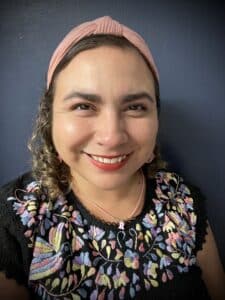
Rocio Castanon – Aspire Lionel Wilson College Prep Academy Alumna
A proud daughter of immigrants and first-generation college graduate, Rocio Castanon has been a steady presence at Aspire Monarch Academyfor the past 15 years. After earning her A.A. in Child Development from Merritt College and her B.A. in Human Development from CSU East Bay, she returned to Monarch, the school her children once attended, to give back to the community that helped raise her.
As a computer skills teacher, Rocio helps students build confidence as creators, not just consumers of technology. She reminds them every day that they are “deeply loved, that they matter, and that it’s always okay to ask questions, speak up, and make mistakes along the way.”
Rocio still carries with her the lessons and encouragement of the many Aspire teachers who shaped her, including Ms. Aguilar, whose third-grade class made her feel seen and cared for, Mr. Peterson, who introduced her to digital design, and Mr. Hasan, who taught her to know her history and herself. She credits many others who pushed her to grow and dream bigger.
Today, Rocio works alongside some of her former students who now serve at Monarch themselves! Her mother has been with Aspire for 25 years, and her sister is now in her third year, making Rocio part of a proud three-generation Aspire family.
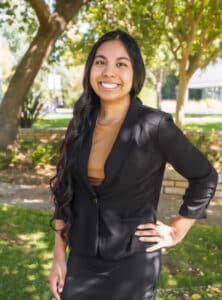
Cathalina Cordero – Aspire Benjamin Holt College Prep Alumna
Cathalina Cordero’s Aspire journey began in kindergarten and continued through Aspire Vincent Shalvey Academy,Aspire Ben Holt Middle School, and Aspire Benjamin Holt College Prep Academy. By the time she graduated high school, she had completed more than 500 hours of community service, led numerous school-based initiatives, and earned over 60 college units through dual enrollment at San Joaquin Delta College. Cathalina went on to UC Davis, graduating in just two years with degrees in Psychology and Sociology. Her commitment to service never wavered—she led community projects as Vice President of Service in Circle K International and supported college access efforts as a tour guide and outreach assistant. This school year, Cathalina returns to Aspire as an Education Specialist Teacher at Aspire Port City Academy, while also pursuing a Doctorate in Counseling Psychology at the University of the Pacific. With every step, she continues to uplift the next generation of Aspire scholars.
Sergio Uzziel Martinez – Aspire Pacific Academy Alumnus
Since graduating from Aspire Pacific Academy, Sergio Uzziel Martinez has remained deeply rooted in his commitment to education and growth. He has earned both his bachelor’s and master’s degrees and recently completed his first year as a full-time English teacher—a role he takes on with gratitude and pride. For Sergio, teaching is not just a profession; it’s a way to “honor the educators who supported and believed in him.” Through his work in and beyond the classroom at Aspire Ollin University Prep Academy, he aims to carry their legacy forward and create the same kind of transformative experiences for his students.
These outstanding alumni continue to reflect Aspire’s mission in action, showing what’s possible when education, community, and leadership intersect. We are thrilled to celebrate their stories!
University of the Pacific opened its classroom and laboratory space to some of the Stockton area’s top high school students during a pilot engineering course, allowing them to earn college credit while exploring future areas of study.
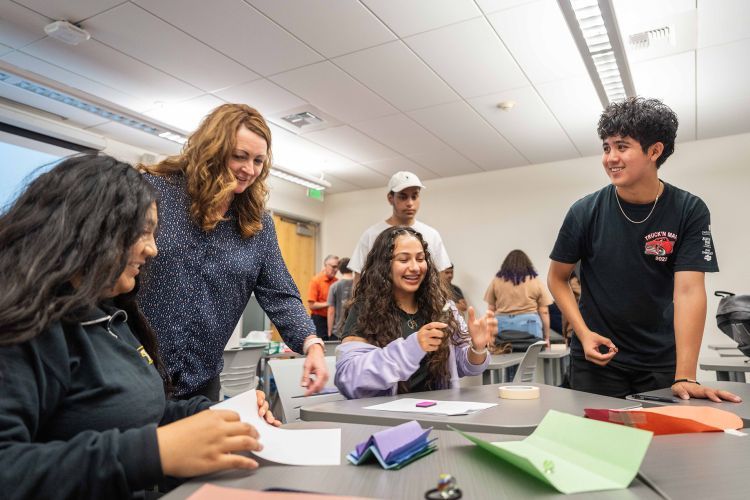
On Wednesdays during fall term, 25 students from Aspire Benjamin Holt College Preparatory Academy and Aspire Langston Hughes Academy, both Stockton schools, attended the Introduction to Engineering class at the John T. Chambers Technology Center on the Stockton Campus. The one-unit college class was taught by School of Engineering and Computer ScienceDean Elizabeth Orwin, who brought in other faculty and staff leaders to illustrate different areas of engineering.
“Many students do not know a lot about engineering, but they are intrigued by the concepts,” Orwin said. “We are introducing them to the engineering design process and to the various disciplines, such as civil, mechanical, computer engineering and more.”
Anthony Solina, executive director of Aspire Public Schools of the Central Valley, emphasized that students benefit from being around academic excellence, including Pacific’s engineering and computer science programs, where more than 90% of students have a job awaiting them at graduation.
“They see more than potential careers; they see career pathways—answers on how they can get to where they want to go,” he said. “With the guidance they received at Pacific, many are now looking to go into engineering, and they are doing so with confidence.”
I am now 100% firm that I want to major in STEM. This is the class that made me want to be an engineer.
– Angel Perez, student
On December 6, family members, high school officials and others gathered at the Don and Karen DeRosa University Center to watch students showcase their final projects during the Pacific Pilot Showcase and Celebration.
Students worked in teams and the assignment for each was to construct a paperweight advertising engineering at University of the Pacific that could be given to prospective students or donors. Many teams worked Power Cat, Burns Tower or other notable Pacific icons into their designs.
“We worked as a team, and that was a great experience. I have never been so infatuated with academia as I was with this Pacific class,” said Angel Perez, a Langston Hughes student. “Every time I went to class it seemed like I learned how something works and why it works. I am now 100% firm that I want to major in STEM. This is the class that made me want to be an engineer.”
Diorue Hodges, a fellow Langston Hughes student, said the course also shifted her career plans to engineering.
“I always wanted to be a nurse or a doctor, and I didn’t even think of engineering as a career pathway,” Hodges said. “I was exposed to the thinking behind engineering and it changed everything. There are low levels of women, particularly Black women, in STEM and engineering and I want to be an inspiration for leading others into the field.”
The percentage of women in the field is estimated at 25%. Dean Orwin’s goal is to raise that to 50% in the School of Engineering and Computer Science.
Twenty-five students attended the one-unit college course taught by Dean Elizabeth Orwin.
The class provided students with hands-on experience. During one session, assignments included dissecting and rebuilding sheep eyeballs. Students also worked in teams to build make-shift pinball machines and shoot for a specific time—eight seconds—for the pinball to reach its destination.
Dario Preciado, a student at Benjamin Holt Academy, proved adept at dissecting the eyeball with guidance from Orwin, whose research focuses on the study of the cornea.
“It felt squishy, which is about what I expected,” he said. “We are trying to learn what engineers do. I personally am considering what I would like to study, so I am trying out different things.”
Alejandro Guerrero and Jazmyn Corona of Benjamin Holt Academy were on a five-person team that worked on the pinball challenge. Using cardboard, tape and propping a desk up with textbooks, they built a pinball course and tested it dozens of times.
The team’s best effort was 8.08 seconds.
Provost and Executive Vice President for Academic Affairs Gretchen Edwalds-Gilbert said she is pleased to have the students on campus and eager to adapt what is learned from this pilot for use in other fields of study.
“Coming to campus is a key component of the model since students have the semester to get comfortable in class,” she said. “Collaborating with the high schools on students’ needs and interests is also important. We hope to see offerings across disciplines as we move forward.”
Another engineering course is set for the spring semester and Pacific administrators have contacted school officials to discuss similar courses in other disciplines. Pacific is exploring courses in teaching and education, business, digital media, sustainability, health sciences, computer science, sports medicine, anatomy, kinesiology, sports analytics, sports management, music industry, pre-health and pre-law.
For more information on Pacific college-credit courses for high school students, contact Ashley Williams at awilliams4@pacific.edu.
By Hannah Workman | October 3, 2022 Original article here.
Stockton native and veteran educator Anthony Solina has been tapped to lead Aspire Public Schools’ 16 Central Valley schools, including its 10 Stockton schools, as the organization’s new Central Valley executive director.
Solina will be responsible for the overall performance of all schools in the Central Valley region. Aspire is the largest public charter school organization in California, with over 30 schools in the Central Valley, the Bay Area and the Los Angeles regions.
“Aspire is ‘College for Certain,'” Solina said, referencing the K-12 school system’s motto. “That doesn’t mean we’re taking college ready kids to start, but it’s about creating a belief in the students early that they can go and then by high school it becomes real.”
Solina has been with Aspire for 20 years, first starting as an elementary school teacher in 2002. He was a founding teacher at two Aspire schools in Stockton: Aspire River Oaks Charter School and Aspire Langston Hughes Academy. He then segued into administration and became the founding principal of Aspire Port City Academy in 2007.
Solina said his primary goal will be the same one he has had since he first stepped foot in a classroom — to make sure every student is college and career ready by graduation.
Solina said at Aspire, students can begin taking college classes when they’re in high school as part of its early college high school program. The program gives students the opportunity to earn a minimum of 30 units or graduate with an associate’s degree.
Aspire is also looking to bring a career pathways program to its Stockton schools, Solina said.
“In Modesto, we have a health careers academy that’s partnered with Modesto Junior College and the students are on a health careers pathway,” Solina said. “They can take courses in radiology, nursing, anatomy, physiology … so we’re piloting that in Modesto and that’s been a great experience so far, but we’re thinking about in Stockton, potentially partnering with [San Joaquin] Delta College and University of the Pacific on an engineering pathway.”
According to Solina, Aspire also is considering is a teacher career pathway. He said it is his hope that this pathway would not only help students find fulfilling careers, but also address the on-going staffing and teacher shortages in San Joaquin County.
“We’re just finding it a huge problem in the pipeline,” Solina said.
A survey recently conducted by EdSource found that the Stockton Unified School District is among the districts with the most significant staffing and teacher shortages in California.
While there is not an exact launch date for the teacher career pathway program yet, Solina said there are plans to pilot the program next summer. Meanwhile, he is looking to provide more opportunities for students to gain hands-on work experience.
“The more we can get connections with local businesses and get students into places of work to learn both the work skills and the life skills, as well as the academic needs for those careers, is where we’re hoping to head to first,” he said.
Record reporter Hannah Workman covers news in Stockton and San Joaquin County. She can be reached at hworkman@recordnet.com or on Twitter @byhannahworkman. Support local news, subscribe to The Stockton Record at https://www.recordnet.com/subscribenow.
As schools nationwide scramble to hire special education teachers after a pandemic-exacerbated shortage, a California charter network is turning to existing staff to fill classroom slots by paying for costly credential programs, boosting salaries, and providing mentors.
“I’ve seen this across systems, not just Aspire, where we have these great educators in our schools, who just need support in accessing credential programs,” said Aspire Charter Schools senior special education director Lisa Freccero. “They’re invested in our schools; they want to work with our kids; they want to work in special education.”
Facing similar vacancies, Aspire is acting fast to scale up their small grow-your-own program. So far, seven educators across their network of 36 California sites have participated.
Now in its third year, Aspire’s Education Specialist Intern Sponsorship program creates a pipeline of school volunteers and classroom aides “already in the door,” Freccero said, providing a pathway for uncredentialed staff, predominantly Black and Latino adults — who also reflect the network’s 15,000 students — to stay with the school community.
Aspire staff are hired on as first year teachers at a salary of $56-59,000. Through one-on-one coaching with administrators — including feedback from senior teachers on recorded lessons — specialist interns learn by doing, applying strategies with students in real time, with daily guidance from their senior mentor.
Even before the pandemic, Aspire’s Bay Area and Central Valley schools had persistent staff vacancies in special education. The last year saw specialist vacancies grow in their Los Angeles schools, where the Sponsorship program is now being expanded.
One East Oakland site is operating with three full-time special education aides, about half of their usual team of five to six. Their Bay Area schools have the highest shortages, currently filled by contractors or substitutes, though all regions have vacancies in every special education role — from speech pathologists and specialists/teachers to school psychologists.
Lisa Freccero
“It’s a high turnover profession… We were trying to solve for that,” Freccero added. “When we talk to them, for the vast majority, [the] barrier was having to either stop their current job or simultaneously figure out a way to pay to go back to school and do a credential program.”
Michelle Ciraulo, a teacher in one of Aspire’s 36 schools in East Oakland, was planning to do just that: save up at least $10,000, while working full-time, to enroll in a credential program. If certified, she’d have a better chance of staying with her caseload of 10th- and 11th-graders and earn higher wages.
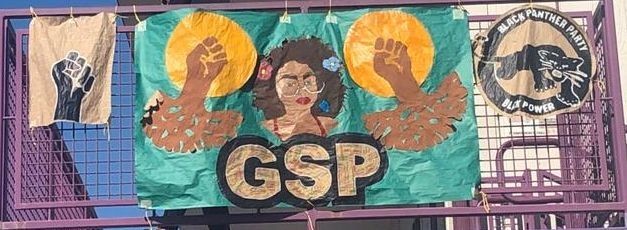
Entrance art at Aspire’s Golden State Prep, where Michelle Ciraulo teaches, in Oakland, California.
“The cost was a hindrance. I wanted to become an ed specialist next year, but I would have probably ended up having to do that with an emergency certification, which you can only do for one year,” she said. “[This] definitely sped up the process.”
Ciraulo said she is also more in tune with general education teachers who she partners with in an inclusion class. Students with IEPs are assisted in general education classrooms.
The connection between teachers is necessary, she said, to make stronger lesson plans and better support students. The program enabled her to form deeper connections with students, too.
“It was really a big incentive for me to just become a specialist but also to stay at this school site and continue to work with my kids and get to know them really well — and their families,” Ciraulo said.
Michelle Ciraulo
Colleagues say that the model can also help prevent burnout many career educators experience around their fifth year. After juggling student caseloads, paperwork and learning to teach — often with little feedback or support networks — many feel overwhelmed from year one. Aspire’s model cuts down on learning curves via multiple mentors and gradually-increasing caseloads.
“Where do you think we should go next … What data do you want? What data do you need? What assessment should you use? … It takes a while to get that knowledge,” senior special education teacher Suzanne Williams said. “When you already have somebody right there next to you who has that knowledge, it’s beautiful, and it benefits the students the most.”
A parent of students with disabilities who started out as a volunteer in her childrens’ schools, Williams added that the first three years are typically the hardest for new teachers she’s witnessed in Modesto, a small city southeast of San Francisco. Williams said her mentee Stephanie’s first years were a success because of the Aspire model.
“She didn’t have to guess — she had somebody right there to ask. When she was writing her lesson plan, she was actually writing lesson plans that she was using each and every day […] She was all in 100% from the get go. We gave her a light caseload and then she worked her way up,” Williams said.
Suzanne Williams with one of her students.
Stephanie would record general education teachers’ classes and her own instruction, and the three educators would pour over them in detail, providing and adapting to feedback. And in built-in “dry runs,” Williams roleplayed students as Stephanie practiced lessons.
The mentorship took out the guesswork that typically comes with being the only, or one few, special education specialists at a site. By the end of the one-year program, Williams said it felt like her mentee had gained three years of experience.
“She’s not focusing on all the things she needs to learn and needs to be. She already has that mentor right there, working hand in hand […] The person is going into that situation prepared or feeling confident,” Williams told The 74. “A confident teacher brings confidence to the students.”