Skip to Main Content

California Parents Push Legislators to Change School Funding System

California Parents Push Legislators to Change School Funding System

By: Ryder Barrios, Omar Rodríguez, Miguel González, Emilio Colima
Journalism Students, Aspire Vanguard College Preparatory Academy
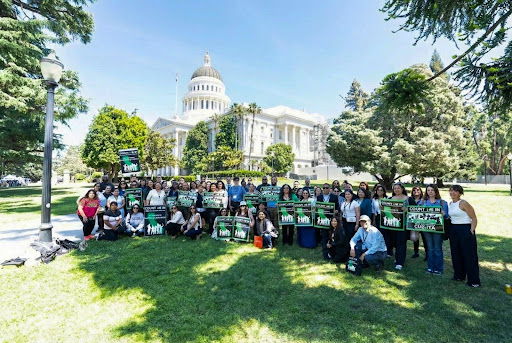
Attendees posing in front of the Capitol building after the first half of the legislative meetings (Photo supplied by Filmtwist)

Families across California have joined Aspire Public Schools in their fifth annual “Count Me In” event from April 6th to 7th, meeting with legislators thirty-five times in one day to combat the current funding system based on average daily attendance (ADA).

The ADA funding formula, introduced to California in 1911, has received increased pushback in recent years. It works by funding schools based on attendance. According to a report from Policy Analysis for California Education (PACE), schools lose $3.6 billion annually due to these absences. 

The Count Me In Movement, led by Maribel Sainez, Aspire Director of Family Engagement and Community Advocacy, is backed by teachers and families across the state. Together, they are combating this funding policy, which they describe as outdated. According to the Count Me In Campaign Overview, it is still used in only six states, including California.

Chronic absenteeism in California is seen in about 1.2 million students who miss 10% of the entire school year on average, according to the overview. Furthermore, a key fact of this overview states that “Students of low-income families—who make up about 62% of all California students — are more likely to miss school—amplifying inequities.” 

Senator Marie Alvarado-Gil shares concern with the current system at the Count Me In Press Conference in front of the California Capitol Building (Photo supplied by Filmtwist)

Parents, students, and teachers say the one-size-fits-all funding system is not working. The Count Me In Campaign Overview states it compounds the problem by withholding funding for their education when absent, further disadvantaging the students and schools who need the most support.

Aspire, along with other charter school management organizations, including KIPP SoCal, Ednovate, Alliance, Camino Nuevo, Brightstar, Voices, Semillas, and Navigator Schools, believes this change in funding is needed to make up for the lost opportunities in school that teachers and parents alike are worried about. Paulette Gipson, a grandparent concerned with current emotional support funding, argued that schools need to be “a safe haven for students to be comfortable in.” 

Nancy de Ramirez, an Aspire parent, said California “needs to restore and add more funding for districts serving students with higher levels of need.” 

Pamela Aaracely Ramirez Herrera, an elementary school teacher, shared that her school was required to front the cost for mandated services for specific students with Individualized Education Programs or IEPs. She questioned the ability of schools to manage all of these requirements at the same time with limited money.

Though the concerns for schools’ addressing of health did not end there. Aaracel continued, revealing that the school did not have the money to hire a nurse. This statement was met with other parents chiming in with their similar experiences.

Lost funding for schools not only affects the school but also the students who attend it, and their families. Sometimes students miss school not because they don’t want to go, but because they can’t.

Iracema Velasquez, an Aspire Richmond Technology Academy parent, shared that her son wouldn’t communicate with teachers or staff throughout the school day and often had accidents when going to the bathroom because he wouldn’t tell teachers he needed to go.

Later on, her son was diagnosed with selective mutism, a severe anxiety disorder where children or adults cannot speak in specific social situations, with this affecting the child’s social skills.

“This is a huge problem because when it came time to take him to school, he did not want to go and would cry; sometimes she had to be at school every day for about twenty minutes waiting for her son to calm down and enter school. On the days he wouldn’t attend school, the school lost funding, and losing this funding means the school cannot hire specialists to deal with these types of problems; in general, it affects the child’s education.”

Another parent at the event stated that her son would sometimes miss school because of the 40-45 minute drive to school and back. She shared, “I live far away from the school, but don’t want to send my son on public transport because it is dangerous, and I don’t trust it.”

She also mentioned having to stop buying certain things for her house to be able to keep up with the rising gas prices. If schools were better funded, parents would not have to worry about transportation, as schools could provide that transport for students.

The lack of funding is a major issue for schools, largely due to the way state funding is distributed. Currently, funding is based on student attendance; however, this approach is problematic due to the high rate of student absenteeism. Many students are missing school, and this directly reduces the resources available to their schools. Furthermore, the current system fails to account for the fact that every child has unique learning needs.

The families who gathered today all had one single goal in mind: to make a better future for their children and future generations. The funding has had a significant impact on the entire school system, specifically the students. 

The cause continues as Aspire, along with many other organizations, works towards next year’s gathering. This fight for a supportive funding landscape will take time, resources, and understanding from the legislature. However, they need not do it alone; vote, petition, and support here.

Crowd applause from supporters after the parents’ speech at the press conference (Photo supplied by Filmtwist)

The Mercury News | Opinion: To better support California’s students, change our funding formula

By funding based on enrollment instead of attendance, we can increase resources to schools with the most vulnerable kids

Original article here.
By Mala Batra | CEO, Aspire Public Schools

June 26, 2024

Photo of Mala Batra CEO, Aspire Public Schools

There is no doubt: Kids are missing a lot of school. Nationally, over a quarter of public school students were chronically absent last year — up from about 15% before the pandemic.

Kids in California are no exception. Recent reporting by the Bay Area News Group said the average California student missed 14.6 school days last year.

This is happening for many reasons, including transportation and mental health issues. Perhaps most daunting is the idea that the pandemic altered society’s relationship with schooling, shifting attendance to be viewed as “optional.” We are already seeing the consequences.

The absenteeism increase has also illuminated an inequity in how California funds public schools. Our state’s schools lose about $3.6 billion annually because of student absences, this paper reported. This is because, currently, California funds schools based on the average number of students who attend school each day. That’s different from the number of students enrolled — for whom the school is responsible for educating. We’re one of only six states that still fund schools this way.

Students from low-income families — about 60% of students — are more likely to miss school. Kids who miss a lot of school often need support. Yet when they’re absent, the state does not offer support. Instead, it withholds money for their education. This means schools serving low-income students often wind up with less funding than more affluent schools, hindering educators’ ability to tend to students’ needs and improve academic outcomes. This is inequitable — but we have an opportunity to address it.

Our experience at Aspire Public Schools has taught us that countering chronic absenteeism requires a thoughtful, resource-intensive approach. We serve over 15,000 students, the vast majority of whom are experiencing poverty. We offer attendance incentives, transportation supports, direct outreach to families and mental health supports, to name a few. Those efforts are meaningful — our schools had an average chronic absenteeism rate of about 26% this year (nearly the same as the state’s), down from about 40% two years ago.

We are relentless in our pursuit because we care about our students, we value their presence in our community, and we know that they have to be in school to learn. But it’s a crisis that a quarter of students at Aspire — and statewide — are chronically absent. While hardworking educators will surely continue working to solve this problem, that will not fix the funding inequity under the surface.

California lawmakers should change how schools are funded to provide resources for the number of students schools are charged with serving. We’ve launched a campaign to help make that happen.

By funding based on student enrollment, we can increase resources for schools serving the most vulnerable kids. One report estimates that about 90% of districts would receive more funding under an enrollment-based formula. The biggest boost would happen in districts with high percentages of low-income, English learner and foster youth students.

Sen. Anthony Portantino’s Senate Bill 98, co-sponsored by State Superintendent Tony Thurmond, would require that the Legislative Analyst’s Office study what this funding change would mean and share findings by 2026. (Whether this would require a change to Proposition 98, the voter-approved initiative that sets minimum funding levels for K-12 schools, would likely be addressed in this study, offering legislators a helpful path.)

This bill, which passed out of the Assembly Education Committee unanimously June 12, would be a strong step in the right direction.

There will be costs associated with changing school funding. We recognize the complex budget situation policymakers face and appreciate that they must juggle competing priorities. But it counters California values to maintain such an inequity. And the costs of our children missing out on their education are far greater.

Every student deserves our support — they all have skills and gifts that should be nurtured. By shifting how our funding formula counts students, we allow resources to be more equitably targeted to students’ needs, including the support needed to attend class. We also send our students a message: You are valued, and your place in our community matters.

Mala Batra is CEO of Aspire Public Schools, a network of charter schools serving over 15,000 TK-12 students across 36 schools in historically underserved communities throughout California.

Aspire Bay Area Public Schools Awarded Over $10 Million in Community Schools Grants

The funding will support partnerships with community agencies and aligning resources to boost student outcomes.

FOR IMMEDIATE RELEASE
May 30, 2024

Media Contact:
Dean Drescher
(919) 270-7766
dean@larsonpr.com

OAKLAND, Calif. — Aspire Public Schools (Aspire) announced today that eight of its Bay Area schools were collectively awarded over $10 million in funding from the California Community Schools Partnership Program. The program, launched in 2022, is part of a seven-year initiative from the state to convert public schools into community hubs that coordinate wraparound services for students and families—like home visits, mental health counseling or after-school care. 

With this funding, Aspire Bay Area schools will be investing in mental and behavioral health supports as well as family resource centers to help streamline service delivery.

“To prepare our scholars for success in college, career, and life, we must support them holistically,” said Mala Batra, CEO of Aspire. “For students to thrive, their  basic needs must  be met. With this critical support, Aspire can better meet the needs of our students and families, creating a more equitable learning environment for all.” 

Aspire is implementing the community schools whole-child approach throughout its network of 36 schools, though different schools are tailoring their strategies based on the unique needs of their students. As one example, Aspire Lionel Wilson College Preparatory Academy in Oakland (Aspire LWP) will be hiring a special populations lead to support programming and professional development for school site staff that centers students with unique needs. 

“This funding supports us in honoring our equity commitment,” said Javier Cabra Walteros, Aspire Bay Area’s executive director. “We are determined to transform the disproportionate academic outcomes that are a product of an unjust system. Community schools are a crucial part of that work. By better addressing students’ academic, physical, and social-emotional needs, we help create the conditions for our communities to thrive.” 

The eight Bay Area schools and their awards are listed below: 

  • Aspire Richmond Technology Academy (Richmond, CA): $1.425M from 23-24 through 27-28
  • Aspire Monarch Academy (Oakland, CA): $1.425M from 23-24 through 27-28
  • Aspire College Academy (Oakland, CA): $1.1875M from 23-24 through 27-28
  • Aspire Triumph Technology Academy (Oakland, CA): $1.1875M from 23-24 through 27-28
  • Aspire BMA (Oakland, CA): $1.625M from 22-23 through 28-29 (this was an original planning grant, now followed by a $1.425M implementation grant)
  • Aspire Lionel Wilson College Preparatory Academy (Oakland, CA): $1.625M from 22-23 through 28-29 (this was an original planning grant, now followed by a $1.425M implementation grant)
  • Aspire EPACS (East Palo Alto, CA): $1.425M from 24-25 through 28-29
  • Aspire Golden State College Preparatory Academy (Oakland, CA): $200k from 23-24 through 24-25 (this is an active planning grant)

Research has indicated that community schools have positive impacts on student attendance, achievement, and behavior. Acknowledging these benefits, the California legislature passed the California Community Schools Partnership Act in 2021, allocating $4.1 billion to the effort—the nation’s largest investment in community schools. The funding has been distributed so far in three rounds, with Aspire schools receiving awards in all three rounds. Funding is available through 2031. 

###

About Aspire Public Schools
Aspire Public Schools operates 36 community-based public charter schools educating over 15,000 students in underserved communities across California. Founded in 1998, Aspire is one of the nation’s largest open-enrollment public charter school systems serving predominantly students of color from low-income communities. Teachers and families partner closely to ensure scholars are prepared to succeed in college, career and life. Currently in its 25th academic year, Aspire is one of the nation’s first charter school systems. Learn more about Aspire Public Schools at aspirepublicschools.org.