California Parents Push Legislators to Change School Funding System
California Parents Push Legislators to Change School Funding System
By: Ryder Barrios, Omar Rodríguez, Miguel González, Emilio Colima
Journalism Students, Aspire Vanguard College Preparatory Academy
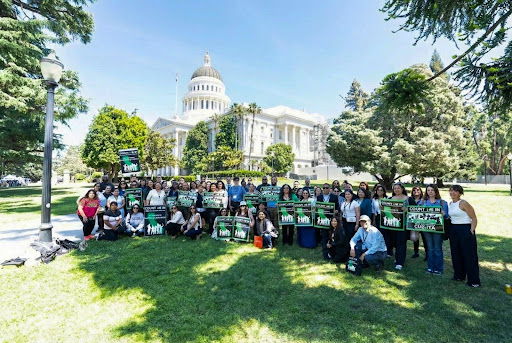
Attendees posing in front of the Capitol building after the first half of the legislative meetings (Photo supplied by Filmtwist)
Families across California have joined Aspire Public Schools in their fifth annual “Count Me In” event from April 6th to 7th, meeting with legislators thirty-five times in one day to combat the current funding system based on average daily attendance (ADA).
The ADA funding formula, introduced to California in 1911, has received increased pushback in recent years. It works by funding schools based on attendance. According to a report from Policy Analysis for California Education (PACE), schools lose $3.6 billion annually due to these absences.
The Count Me In Movement, led by Maribel Sainez, Aspire Director of Family Engagement and Community Advocacy, is backed by teachers and families across the state. Together, they are combating this funding policy, which they describe as outdated. According to the Count Me In Campaign Overview, it is still used in only six states, including California.
Chronic absenteeism in California is seen in about 1.2 million students who miss 10% of the entire school year on average, according to the overview. Furthermore, a key fact of this overview states that “Students of low-income families—who make up about 62% of all California students — are more likely to miss school—amplifying inequities.”

Senator Marie Alvarado-Gil shares concern with the current system at the Count Me In Press Conference in front of the California Capitol Building (Photo supplied by Filmtwist)
Parents, students, and teachers say the one-size-fits-all funding system is not working. The Count Me In Campaign Overview states it compounds the problem by withholding funding for their education when absent, further disadvantaging the students and schools who need the most support.
Aspire, along with other charter school management organizations, including KIPP SoCal, Ednovate, Alliance, Camino Nuevo, Brightstar, Voices, Semillas, and Navigator Schools, believes this change in funding is needed to make up for the lost opportunities in school that teachers and parents alike are worried about. Paulette Gipson, a grandparent concerned with current emotional support funding, argued that schools need to be “a safe haven for students to be comfortable in.”
Nancy de Ramirez, an Aspire parent, said California “needs to restore and add more funding for districts serving students with higher levels of need.”
Pamela Aaracely Ramirez Herrera, an elementary school teacher, shared that her school was required to front the cost for mandated services for specific students with Individualized Education Programs or IEPs. She questioned the ability of schools to manage all of these requirements at the same time with limited money.
Though the concerns for schools’ addressing of health did not end there. Aaracel continued, revealing that the school did not have the money to hire a nurse. This statement was met with other parents chiming in with their similar experiences.
Lost funding for schools not only affects the school but also the students who attend it, and their families. Sometimes students miss school not because they don’t want to go, but because they can’t.
Iracema Velasquez, an Aspire Richmond Technology Academy parent, shared that her son wouldn’t communicate with teachers or staff throughout the school day and often had accidents when going to the bathroom because he wouldn’t tell teachers he needed to go.
Later on, her son was diagnosed with selective mutism, a severe anxiety disorder where children or adults cannot speak in specific social situations, with this affecting the child’s social skills.
“This is a huge problem because when it came time to take him to school, he did not want to go and would cry; sometimes she had to be at school every day for about twenty minutes waiting for her son to calm down and enter school. On the days he wouldn’t attend school, the school lost funding, and losing this funding means the school cannot hire specialists to deal with these types of problems; in general, it affects the child’s education.”
Another parent at the event stated that her son would sometimes miss school because of the 40-45 minute drive to school and back. She shared, “I live far away from the school, but don’t want to send my son on public transport because it is dangerous, and I don’t trust it.”
She also mentioned having to stop buying certain things for her house to be able to keep up with the rising gas prices. If schools were better funded, parents would not have to worry about transportation, as schools could provide that transport for students.
The lack of funding is a major issue for schools, largely due to the way state funding is distributed. Currently, funding is based on student attendance; however, this approach is problematic due to the high rate of student absenteeism. Many students are missing school, and this directly reduces the resources available to their schools. Furthermore, the current system fails to account for the fact that every child has unique learning needs.
The families who gathered today all had one single goal in mind: to make a better future for their children and future generations. The funding has had a significant impact on the entire school system, specifically the students.
The cause continues as Aspire, along with many other organizations, works towards next year’s gathering. This fight for a supportive funding landscape will take time, resources, and understanding from the legislature. However, they need not do it alone; vote, petition, and support here.

Crowd applause from supporters after the parents’ speech at the press conference (Photo supplied by Filmtwist)